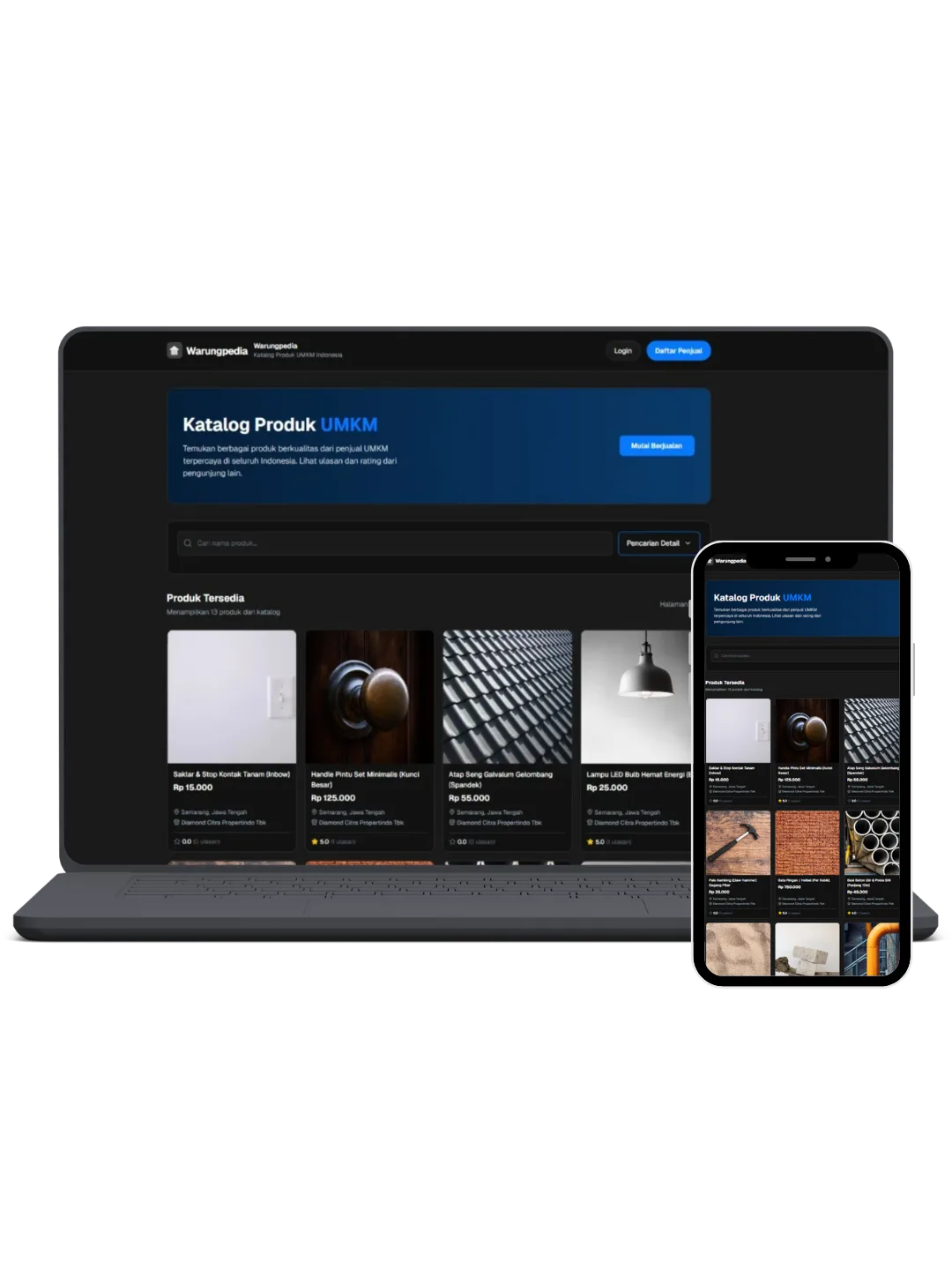
The README documents buyer, seller, and admin marketplace roles as part of the product scope.
Warungpedia
Built as a software-project coursework artefact, Warungpedia translates marketplace roles, discovery, verification, and monitoring into a typed Next.js application backed by Supabase services.
A source-backed case study built for recruiter review
This reading path makes the problem choice, evidence quality, user framing, execution decisions, and proof trail visible without overstating what the sources support.
Marketplace web app project that models buyer, seller, and admin workflows for local UMKM commerce.
Demonstrates product-oriented fullstack thinking by turning a marketplace domain into explicit roles, setup documentation, and maintainable application boundaries.
Next.js App Router application using React views, API route handlers for backend logic, Tailwind CSS for UI, and Supabase for PostgreSQL, auth, and storage concerns.
Problem framing before execution
The case-study layer starts with why this problem was selected and how the context justified investment.
Problem Framing Map
UMKM marketplace workflows require different paths for sellers, buyers, and administrators, making role clarity and data integration central to implementation quality.
Warungpedia is positioned as a software-project coursework artefact built around explicit role modeling, setup documentation, and fullstack application boundaries using Next.js and Supabase.
It is useful for Wave 2 because it adds a practical commerce-oriented fullstack narrative with stronger source-backed implementation detail than a recovered-source candidate.
Problem statement
UMKM marketplace workflows require different paths for sellers, buyers, and administrators, making role clarity and data integration central to implementation quality.
Solution thesis
Structured the project around role-aware marketplace flows, Next.js app routes, API handlers, and Supabase-backed data/auth/storage integration.
What supports the narrative
Evidence is surfaced with its source type and credibility note so the recruiter can quickly see what is directly backed versus intentionally constrained.
The package metadata confirms Next.js, TypeScript, Tailwind CSS, React, and Supabase dependencies.
Credibility Notes
- ●Warungpedia should be presented as a role-aware marketplace implementation artefact, not as a live UMKM platform with verified seller or buyer traction.
- ●No GMV, transaction, retention, or production-operations claim is introduced without stronger evidence.
User framing stays explicit
When formal research artefacts are not available, the page still explains who the work served and why that user framing is justified by the existing sources.
The clearest source-backed differentiation in this project is the explicit role modeling across marketplace responsibilities.
The project's value for the portfolio is in how it translates role requirements into typed app structure and setup guidance.
How design thinking translated into decisions
The goal is to show the trace from research and insight to concrete product or system decisions, then to the outcomes those decisions supported.
Design Thinking Flow
Each step keeps the movement from evidence to action explicit before the rationale expands it.
- Step 1Role clarity first
Started by framing the marketplace around distinct actor responsibilities rather than building generic screens.
Signal: Buyer, seller, and admin pathways became the organizing model. - Step 2Unified app boundary
Used one Next.js App Router application to keep UI and API route handling close to the same domain logic.
Signal: Fullstack reasoning stays understandable for a coursework-sized implementation. - Step 3Setup-aware delivery
Included Supabase environment and onboarding guidance as part of the implementation story.
Signal: The project is easier to review as a real fullstack artefact, not only a code snapshot.
Decision Rationale
Each decision keeps the path from insight to execution visible before ending on the outcome signal.
Marketplace apps become confusing when multiple actor journeys are collapsed into one generic flow.
Structured the application around buyer, seller, and admin marketplace workflows.
The project demonstrates product-oriented fullstack thinking through clearer role boundaries.
A commerce-flavoured learning artefact becomes more convincing when auth, database, and storage concerns are treated together.
Used Supabase for PostgreSQL, auth, and storage integration inside the application narrative.
The implementation reads as a more complete fullstack system without overstating production maturity.
Execution choices and delivery details
This section preserves the technical and operational substance: architecture, responsibilities, trade-offs, and implementation quality signals.
System Design
Next.js App Router application using React views, API route handlers for backend logic, Tailwind CSS for UI, and Supabase for PostgreSQL, auth, and storage concerns.
Source-backed Impact
Demonstrates product-oriented fullstack thinking by turning a marketplace domain into explicit roles, setup documentation, and maintainable application boundaries.
Responsibilities
- ●Translated marketplace role requirements into application structure
- ●Prepared Supabase environment and database setup guidance in project documentation
- ●Organized frontend and API implementation around role-specific marketplace workflows
Stack Decisions
- ●Used Next.js App Router to keep UI and API route handling in one application boundary
- ●Used Supabase to cover database, authentication, and storage integration needs
- ●Used TypeScript and Tailwind CSS to keep implementation typed and UI iteration consistent
Trade-offs
- ●Accepted Supabase environment setup dependency for a more complete fullstack learning artefact
- ●Kept the public portfolio framing focused on source-backed structure instead of unsupported production claims
Challenges
- ●Keeping buyer, seller, and admin concerns understandable in one coursework-sized codebase
- ●Documenting environment setup without exposing secrets or implying a live production deployment
What was delivered and what can be verified
Outcome claims remain conservative and source-backed, while proof records and recruiter-safe links surface the strongest verification trail available.
Validation Signals
- ●README documents buyer, seller, and admin marketplace roles.
- ●Local archive includes README and package metadata for reviewer onboarding.
Source-backed Outcomes
- ●README documents buyer, seller, and admin marketplace roles
- ●Source package uses Next.js, TypeScript, Tailwind CSS, React, and Supabase dependencies
- ●Local archive includes README and package metadata for reviewer onboarding
Proof
- Software Project Artefact
Marketplace web app documentation and package metadata available
Links
What the project proves, and what it does not
Strong case studies show both what was learned and where the current evidence stops.
Retrospective
Next iteration should add request-flow diagrams, test evidence, and clearer database migration instructions before claiming operational readiness.
Evidence Limits
- ●Current sources do not provide live marketplace usage, transaction validation, or production deployment proof.
- ●The project should remain framed as a source-backed fullstack artefact for marketplace workflows.
Lessons
- ●Marketplace products benefit from explicit role modeling before UI implementation
- ●Reviewer-friendly setup documentation increases the value of a fullstack portfolio artefact