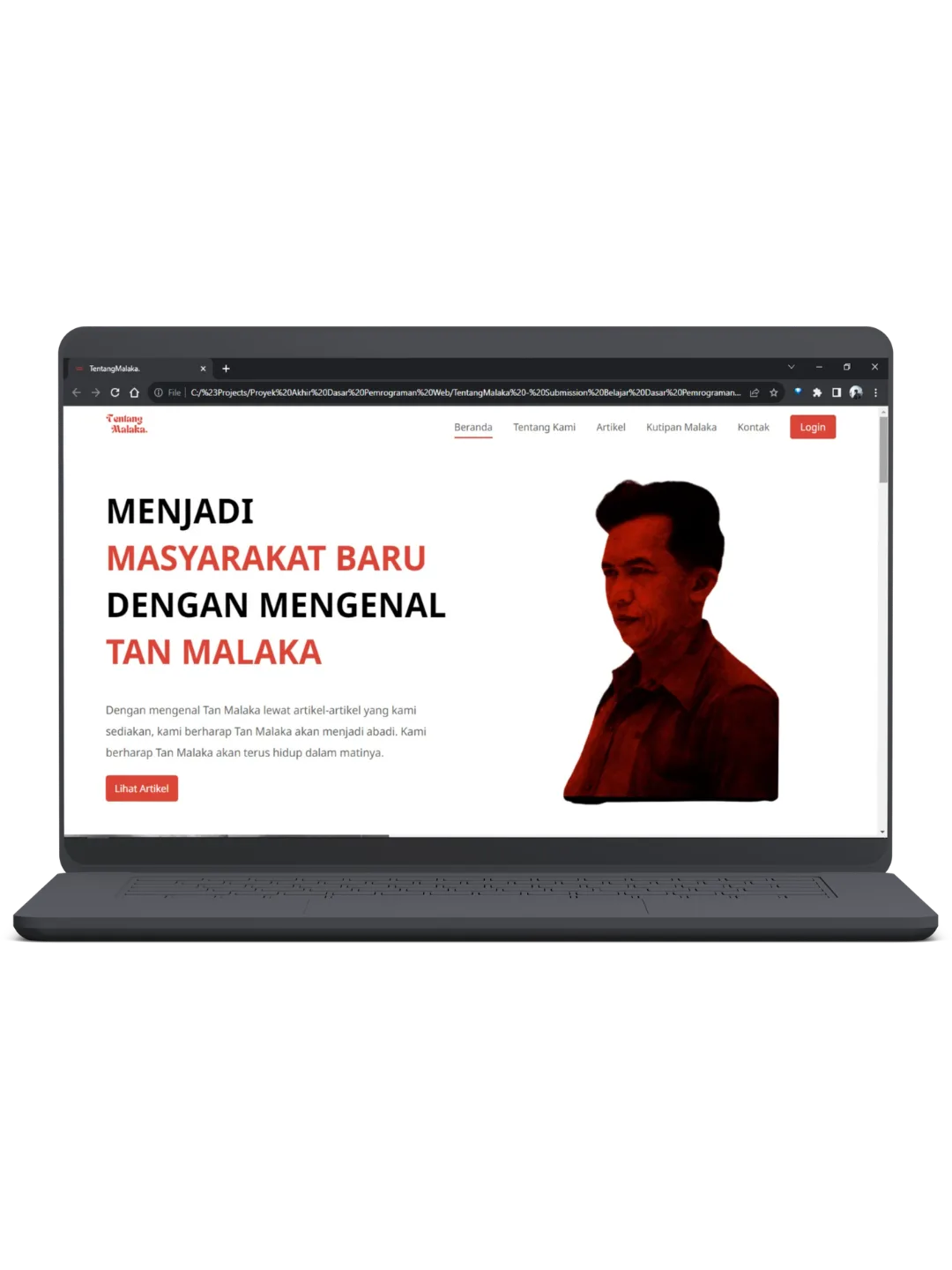
The project record is backed by explicit README, HTML, CSS, and JS source references from the remote repository.
TentangMalaka
TentangMalaka is promoted from recovered remote evidence only: the local archive is empty, while the remote README and static source tree still document the submission clearly.
A source-backed case study built for recruiter review
This reading path makes the problem choice, evidence quality, user framing, execution decisions, and proof trail visible without overstating what the sources support.
Static article-site submission about Tan Malaka built with semantic HTML, CSS layout work, and small JavaScript navigation behavior.
Provides a source-backed coursework artefact for reviewing semantic HTML structure, static layout composition, and front-end content organization without claiming production usage or audience outcomes.
Single-page static site served from `index.html`, styled through `assets/css/style.css`, supported by image assets, and enhanced by `assets/js/script.js` for responsive navigation and smooth scrolling between page sections.
Problem framing before execution
The case-study layer starts with why this problem was selected and how the context justified investment.
Problem Framing Map
A static article site still needs clear semantic structure, layout discipline, and reviewer-visible criteria to stand out as a credible coursework artefact.
TentangMalaka is reconstructed from recovered remote evidence, so every public claim must stay tightly constrained to what the README, source tree, HTML, CSS, and JS files explicitly prove.
It is worth upgrading because it adds a conservative recovered-source case that demonstrates evidence discipline and foundational frontend structure without inventing unsupported outcomes.
Problem statement
The Dicoding basic web-programming submission required a static website that used semantic HTML sections, appropriate content placement, a profile aside, and layout composition with float or flexbox.
Solution thesis
Built a static article website about Tan Malaka with header navigation, main article sections, a quote section, contact/profile aside content, footer structure, responsive styling, and JavaScript-assisted navigation interactions.
What supports the narrative
Evidence is surfaced with its source type and credibility note so the recruiter can quickly see what is directly backed versus intentionally constrained.
The README documents a basic web-programming submission centered on semantic sections and layout structure.
Credibility Notes
- ●Because the local archive is empty, this case stays bounded to recovered remote evidence only.
- ●No readership, engagement, or production-usage claim is made for this project.
User framing stays explicit
When formal research artefacts are not available, the page still explains who the work served and why that user framing is justified by the existing sources.
Its strongest verified value comes from submission criteria and source-tree structure.
The implementation proves content organization and semantic composition, even without live audience evidence.
How design thinking translated into decisions
The goal is to show the trace from research and insight to concrete product or system decisions, then to the outcomes those decisions supported.
Design Thinking Flow
Each step keeps the movement from evidence to action explicit before the rationale expands it.
- Step 1Criteria framing
Used coursework submission requirements as the baseline definition of success.
Signal: Semantic HTML and layout structure became the central proof points. - Step 2Content structure
Organized article content into explicit sections and supporting static assets.
Signal: The recovered source tree stays readable as a small but complete frontend artefact. - Step 3Conservative portfolio mapping
Promoted the project only after remote evidence was explicit enough for factual recovery.
Signal: The portfolio framing prioritizes trust over narrative exaggeration.
Decision Rationale
Each decision keeps the path from insight to execution visible before ending on the outcome signal.
A weakly archived project becomes misleading if portfolio copy extends beyond what recovered files support.
Kept every public claim anchored to the remote README and source tree only.
The project becomes portfolio-safe without overstating its documentation depth.
For a basic web-programming submission, structural correctness matters more than decorative complexity.
Framed the project around semantic sections, layout composition, and small JavaScript behavior.
The artefact reads as solid foundational frontend work.
Execution choices and delivery details
This section preserves the technical and operational substance: architecture, responsibilities, trade-offs, and implementation quality signals.
System Design
Single-page static site served from `index.html`, styled through `assets/css/style.css`, supported by image assets, and enhanced by `assets/js/script.js` for responsive navigation and smooth scrolling between page sections.
Source-backed Impact
Provides a source-backed coursework artefact for reviewing semantic HTML structure, static layout composition, and front-end content organization without claiming production usage or audience outcomes.
Responsibilities
- ●Structured the page with semantic HTML sections for course review
- ●Implemented static article, quote, contact, and profile-oriented sections
- ●Styled the layout and responsive navigation behavior with CSS
- ●Added JavaScript navigation toggling and smooth section scrolling
Stack Decisions
- ●Used plain HTML, CSS, and JavaScript to match the basic web-programming submission scope
- ●Used semantic elements to satisfy the documented course criteria
- ●Used flexbox-backed layout patterns visible in the stylesheet
- ●Kept the implementation as a static source tree without adding a framework or package-managed build step
Trade-offs
- ●Kept portfolio wording limited to README and source-tree facts because the local archive contains no files
- ●Avoided treating on-page article and reader counters as verified metrics because no source proves production readership
Challenges
- ●Organizing article-themed content into semantic sections that remain clear for a course reviewer
- ●Keeping the navigation and responsive layout understandable in a framework-free static site
What was delivered and what can be verified
Outcome claims remain conservative and source-backed, while proof records and recruiter-safe links surface the strongest verification trail available.
Validation Signals
- ●Recovered README, HTML, CSS, and JS references are preserved in the project sources.
- ●README documents fulfilled semantic HTML and layout submission criteria.
Source-backed Outcomes
- ●README identifies the project as a Dicoding Belajar Dasar Pemrograman Web submission
- ●README lists required header, footer, main, article, and aside elements
- ●README lists the requirement to arrange layout with float or flexbox
- ●Remote repository tree includes `index.html`, `assets/css/style.css`, `assets/js/script.js`, and image assets
Proof
- Dicoding Basic Web Programming Submission
README documents fulfilled semantic HTML and layout submission criteria
Dicoding Academy
Links
What the project proves, and what it does not
Strong case studies show both what was learned and where the current evidence stops.
Retrospective
Next iteration should rebuild a complete local archive, replace placeholder article titles with fully sourced content, and add setup notes before claiming stronger documentation or deployment readiness.
Evidence Limits
- ●The local archive remains empty, so this project depends on recovered remote evidence.
- ●Current sources do not support usage metrics, deployment proof, or broader product-outcome claims.
Lessons
- ●Basic static sites become more reviewable when semantic structure and course criteria are documented together
- ●Recovered README evidence can make a small coursework artefact portfolio-safe when claims stay source-bounded