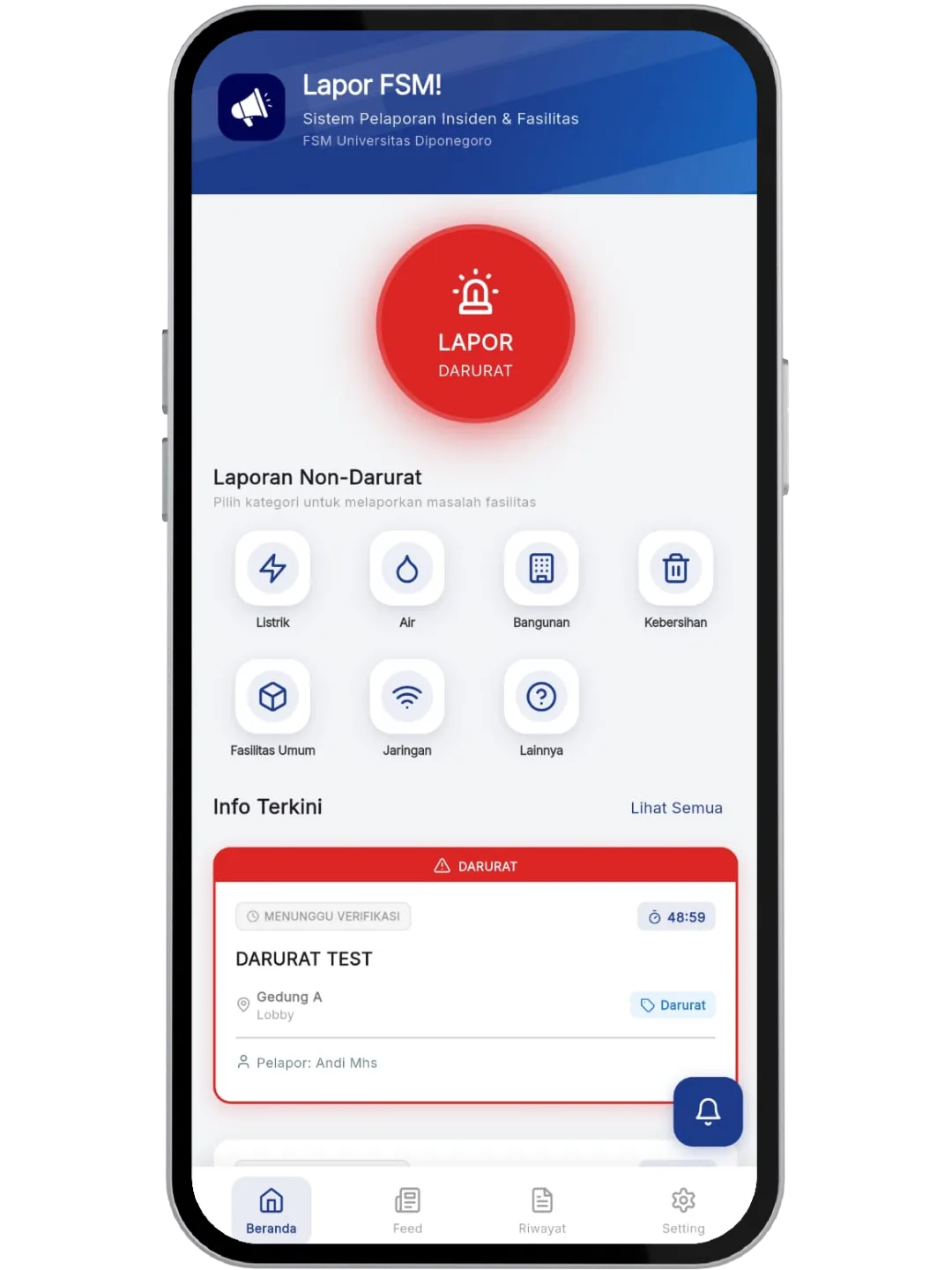
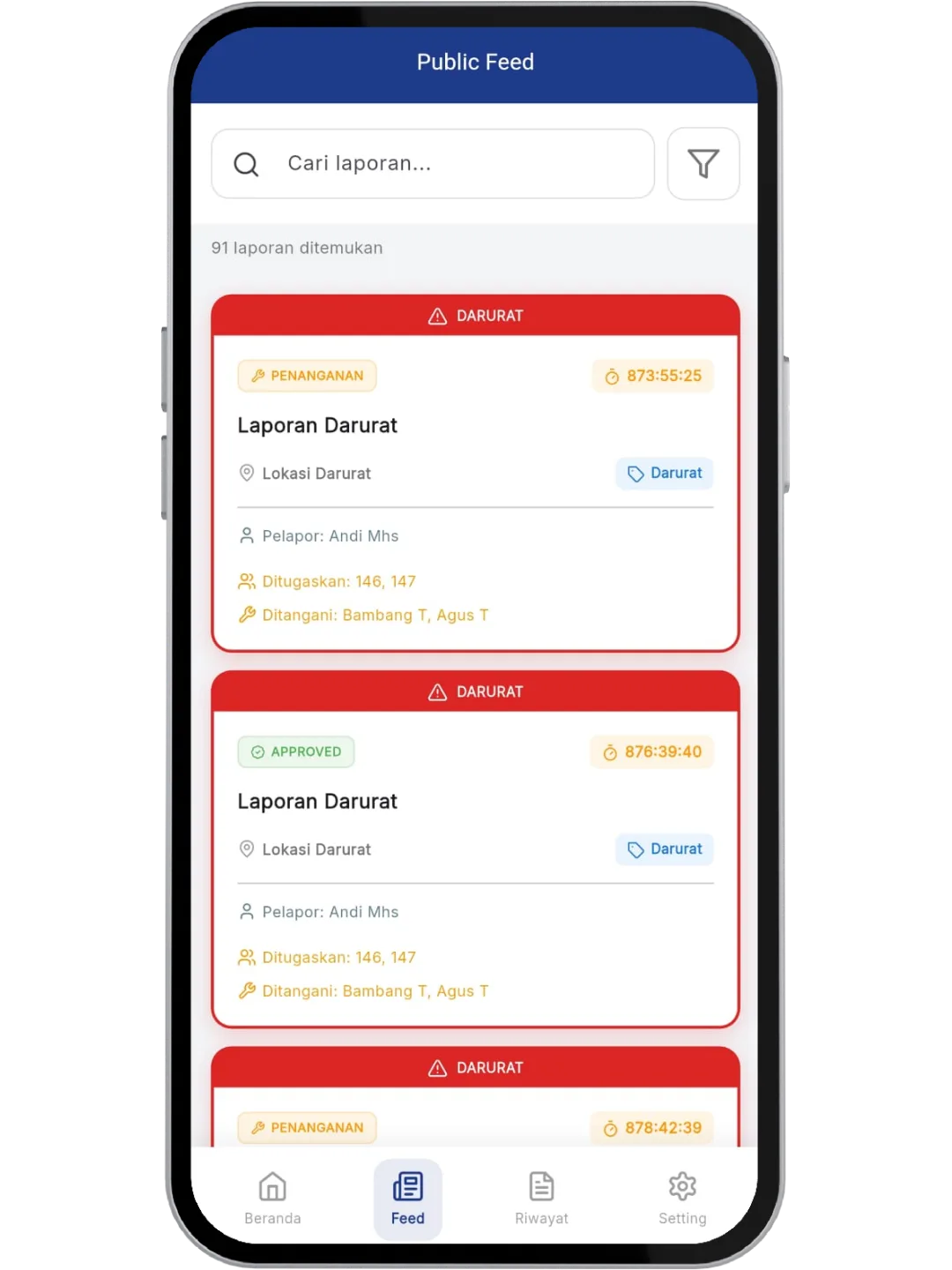
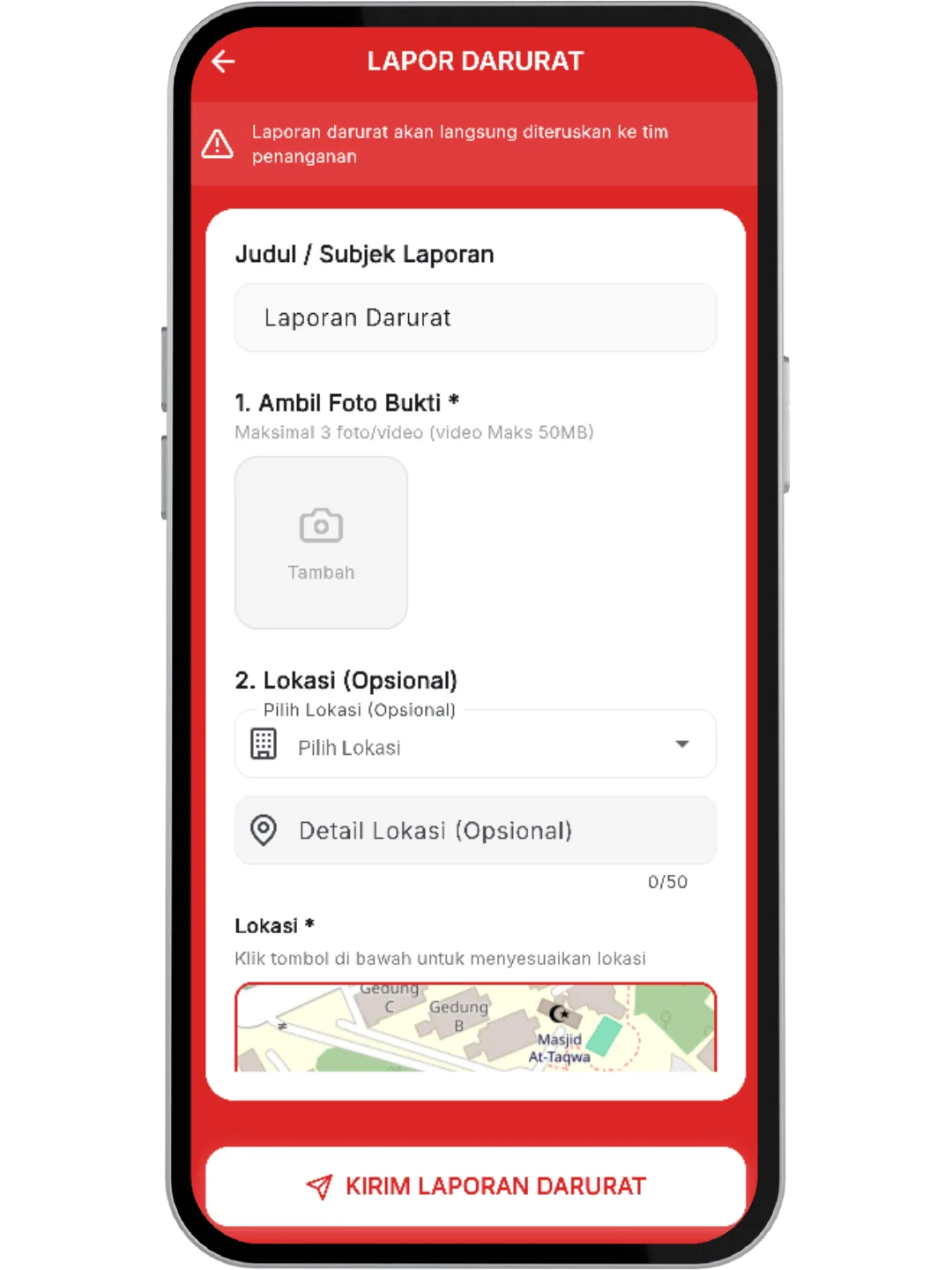
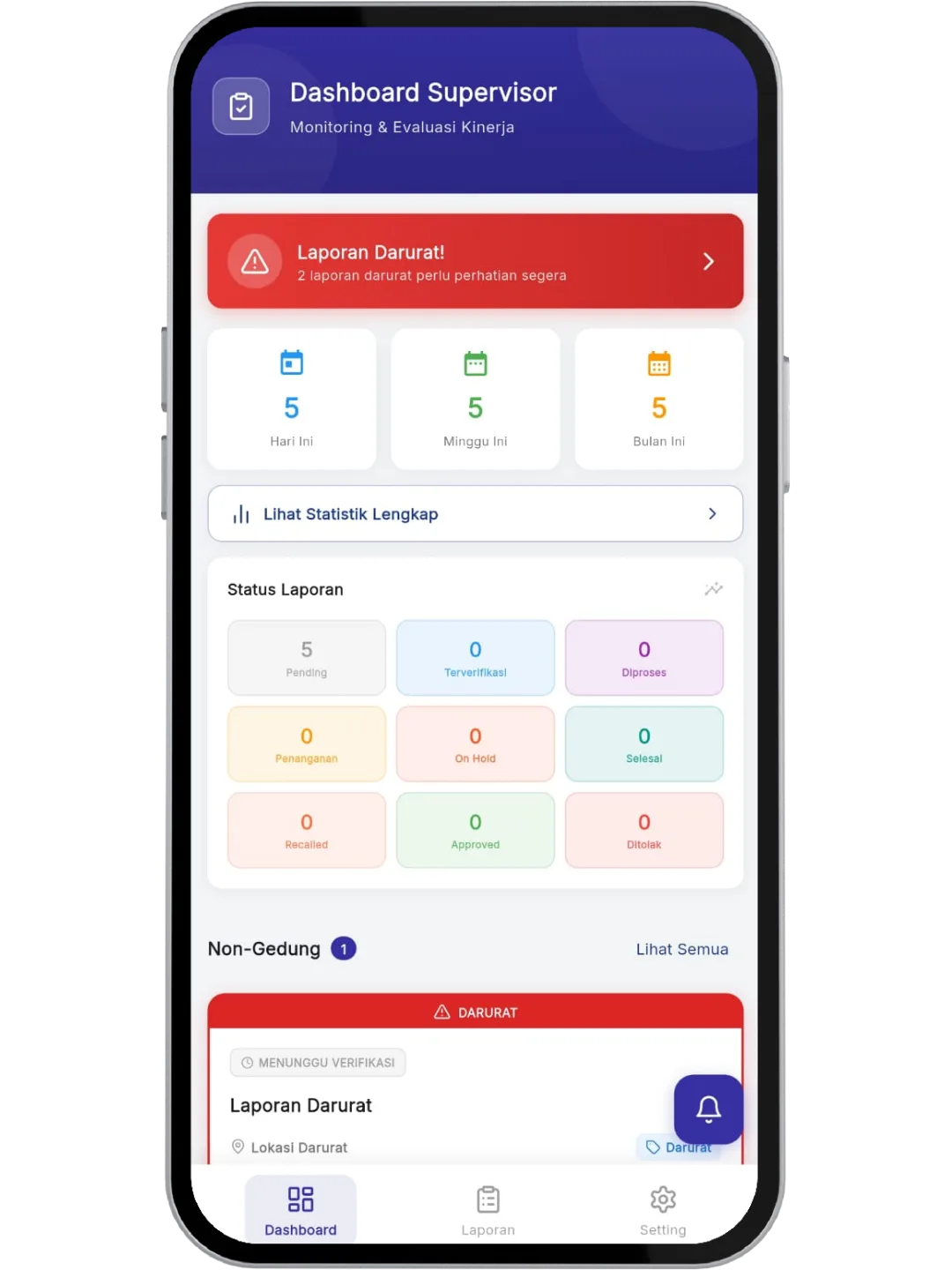
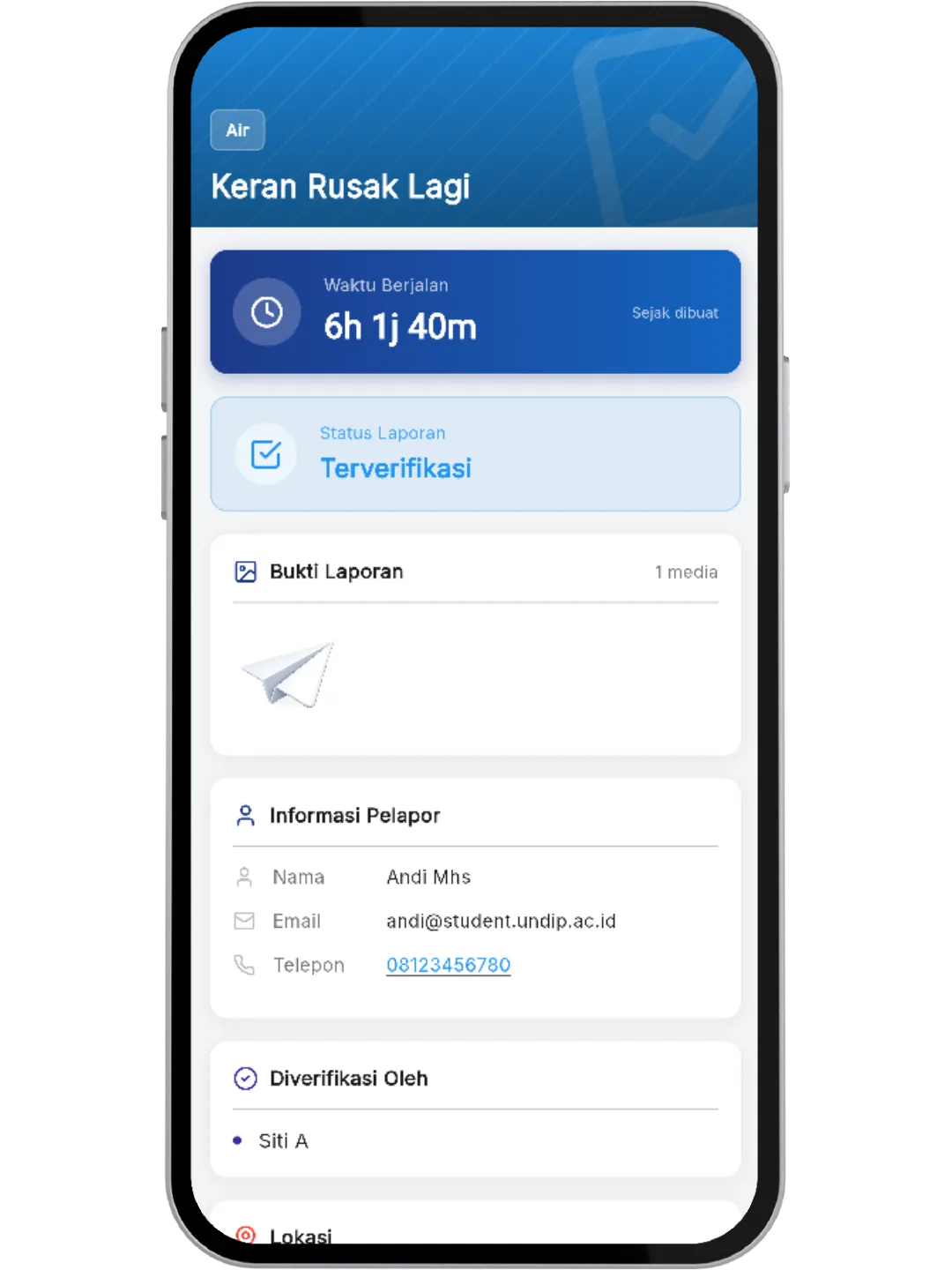
Existing reporting flow was fragmented and slowed coordination during incidents.
Lapor FSM!
Built as a 0-to-1 emergency operations system for FSM Diponegoro University, this project replaced fragmented manual reporting with one shared incident pipeline for reporters and administrators.
A source-backed case study built for recruiter review
This reading path makes the problem choice, evidence quality, user framing, execution decisions, and proof trail visible without overstating what the sources support.
A real-time emergency reporting platform with dual portals and geospatial coordination for campus incident handling.
Improved reporting speed and situational visibility for campus operators and decision-makers during active incidents.
Next.js frontend with an ElysiaJS backend on Bun runtime, PostgreSQL/PostGIS for geospatial data, and WebSocket channels for low-latency updates.
Problem framing before execution
The case-study layer starts with why this problem was selected and how the context justified investment.
Problem Framing Map
Campus emergency escalation relied on fragmented manual reporting and weak shared visibility.
The project was initiated as a 0-to-1 operational platform for FSM Diponegoro University, where reporters and administrators needed a single live incident pipeline instead of disconnected coordination steps.
The problem was worth solving because it combined clear operational urgency, stakeholder demand, and a concrete handoff gap that software could reduce.
Problem statement
Campus emergency escalation depended on fragmented manual reporting, slowing coordination and reducing response visibility.
Solution thesis
Delivered a dual-portal system (reporter/admin) with real-time incident streams, role-based workflows, and map-assisted coordination.
What supports the narrative
Evidence is surfaced with its source type and credibility note so the recruiter can quickly see what is directly backed versus intentionally constrained.
The first milestone centered on a dual-portal launch for reporters and administrators.
Credibility Notes
- ●Public wording stays limited to operational workflow and release facts already documented in documented sources.
- ●No response-time reduction or adoption metric is claimed because the current sources do not quantify those outcomes.
User framing stays explicit
When formal research artefacts are not available, the page still explains who the work served and why that user framing is justified by the existing sources.
The solution includes a dedicated reporter portal, making this user role explicit in the source-backed release scope.
The dual-portal architecture and role-based workflows directly indicate an administrator-facing operational user.
How design thinking translated into decisions
The goal is to show the trace from research and insight to concrete product or system decisions, then to the outcomes those decisions supported.
Design Thinking Flow
Each step keeps the movement from evidence to action explicit before the rationale expands it.
- Step 1Problem framing
Mapped the coordination bottleneck as a workflow problem, not only a form-submission problem.
Signal: Fragmented manual reporting became the core issue to resolve. - Step 2User and workflow definition
Separated reporter and admin needs to keep submission and operational response flows distinct.
Signal: Dual-portal release became the first product milestone. - Step 3Execution focus
Prioritized real-time updates, geospatial context, and role-based states over broader feature breadth.
Signal: WebSocket and PostGIS decisions aligned with situational visibility needs.
Decision Rationale
Each decision keeps the path from insight to execution visible before ending on the outcome signal.
Incident visibility loses value when updates lag behind active field conditions.
Used WebSockets instead of polling for low-latency status propagation.
The delivery story emphasizes live incident streams as a core operational feature.
Emergency handling requires more than text reports when response context depends on place.
Used PostGIS to support geospatial incident handling.
Mapping and location-aware coordination became part of the v1 system baseline.
Execution choices and delivery details
This section preserves the technical and operational substance: architecture, responsibilities, trade-offs, and implementation quality signals.
System Design
Next.js frontend with an ElysiaJS backend on Bun runtime, PostgreSQL/PostGIS for geospatial data, and WebSocket channels for low-latency updates.
Source-backed Impact
Improved reporting speed and situational visibility for campus operators and decision-makers during active incidents.
Responsibilities
- ●Owned architecture and product scope from planning to launch
- ●Defined data model and geospatial query strategy
- ●Coordinated implementation across frontend, backend, and stakeholder feedback
Stack Decisions
- ●Chose Bun + ElysiaJS for runtime performance and fast iteration
- ●Used PostGIS for location-aware incident handling
- ●Used WebSockets instead of polling to reduce alert latency
Trade-offs
- ●Accepted newer runtime ecosystem risk (Bun) for performance gains
- ●Prioritized operational reliability over broad feature breadth in v1
Challenges
- ●Designing stable real-time flows under quick delivery constraints
- ●Aligning technical implementation with stakeholder process requirements
What was delivered and what can be verified
Outcome claims remain conservative and source-backed, while proof records and recruiter-safe links surface the strongest verification trail available.
Validation Signals
- ●Dual-portal release completed as the first production milestone.
- ●Architecture and scope stayed aligned with stakeholder process requirements during delivery.
Source-backed Outcomes
- ●1-month end-to-end delivery cycle
- ●Dual-portal release in first production milestone
- ●Real-time incident updates with WebSocket channel architecture
Proof
- Production Rollout
Dual-portal launch
Jan 2026
What the project proves, and what it does not
Strong case studies show both what was learned and where the current evidence stops.
Retrospective
Next iteration should add SLA tracking and auditable incident trails for stronger service governance.
Evidence Limits
- ●Current sources do not expose formal user-research artefacts, interview counts, or usability-test records.
- ●Current sources do not quantify post-launch SLA improvement, adoption, or incident-resolution deltas.
Lessons
- ●Realtime systems require strict event contracts early
- ●Operational tools need explicit fallback states for incident workflows